




Appearance
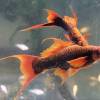
- Color: Predominantly red with iridescent hues and potentially contrasting black or dark red on the dorsal fin and tail (sword).
- Size: Typically grows to about 2.5 to 3 inches (6.4 to 7.6 cm) in length.
- Distinguishing Feature: Males possess a long, sword-like extension on the lower part of their tail fin, which is less pronounced or absent in females. Females tend to be larger and rounder, especially when gravid.
Temperament & Behavior
- Peaceful & Social: Generally compatible with other non-aggressive fish in a community tank.
- Active: Enjoys exploring and swimming throughout the tank, particularly in the middle and upper water levels.
- Potential for Aggression: Male swordtails can exhibit territoriality towards each other, especially when multiple males are present. Maintaining a higher ratio of females to males (e.g., 4 females to 1 male) is recommended to minimize aggression.
Breeding
- Livebearers: Give birth to live young instead of laying eggs.
- Prolific Breeders: Females can store sperm and give birth to multiple broods (20-100 fry) every 28-63 days, depending on temperature and conditions.
- Breeding Setup: Provide plenty of dense plants for fry to hide, or move the pregnant female to a separate breeding tank to prevent adults from eating the young.
Lifespan
- Average Lifespan: Typically 3-5 years with proper care and stable living conditions.
Tank and Water Requirements
- Tank Size: Minimum of 15 gallons for a single fish, and ideally 30 gallons or larger for a small group or community tank.
- Water Temperature: 65°F to 82°F (18-28°C), with 75-79°F being the optimal range.
- pH Levels: Slightly alkaline, ranging from 7.0 to 8.4.
- Water Hardness: 12 to 35 dGH (very hard).
- Filtration & Circulation: Good filtration and moderate to strong water flow are important to maintain water quality and mimic their natural habitat.
- Decor: Include plants (live or artificial) for hiding spots and open swimming areas. Java fern, Anubias, and Amazon swords are suitable choices.
- Tank Lid: A secure lid is crucial, as swordtails are known for their jumping ability.
Diet
- Omnivorous: Enjoy a varied diet including high-quality flake or pellet food, as well as live or frozen foods such as brine shrimp, bloodworms, and daphnia.
- Supplementation: Provide vegetable matter like spirulina-based flakes or blanched vegetables (e.g., zucchini, spinach) for optimal health and color.
Tankmates
- Compatible: Mollies, guppies, platies, gouramis, tetras, rasboras, rainbowfish, danios, and corydoras catfish are good choices.
- Considerations: Avoid aggressive or boisterous fish that might stress the swordtails or fin-nip. Choose tank mates with similar water parameter preferences.




Reviews
There are no reviews yet.